

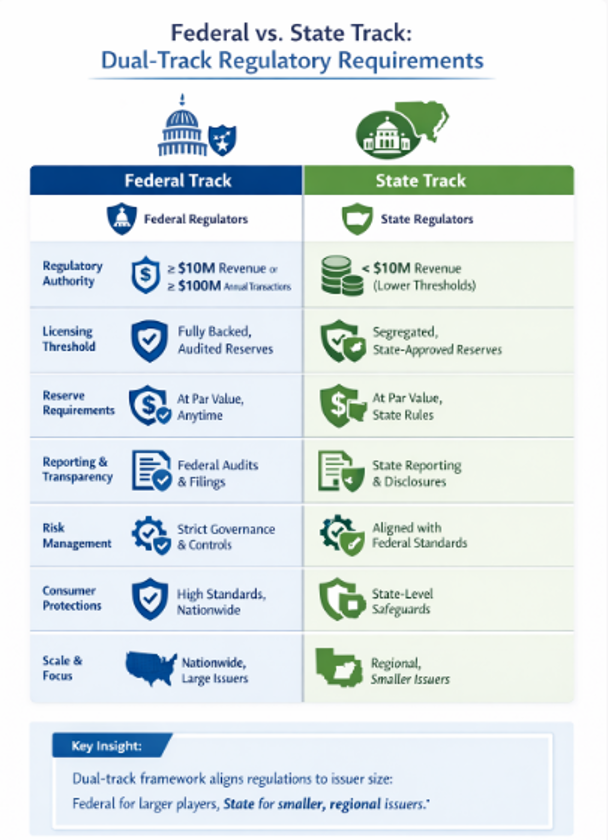
The GENIUS Act defines two regulatory pathways, each with specific obligations and revenue-related licensing thresholds:
Federal Track
Issuers under federal supervision must meet national standards, including:
- Reserve Requirements: Maintain fully backed, high-quality reserves.
- Redemption Rights: Ensure stablecoin holders can redeem coins at par value at any time.
- Transparency and Reporting: Submit regular audits and disclosures to federal regulators.
- Risk Management: Implement governance, operational, and financial controls to mitigate systemic risks.
- Revenue Requirements: Federal licensure typically applies to issuers with annual transaction volumes exceeding $100 million or annual revenue from stablecoin operations exceeding $10 million. This ensures the framework targets systemically significant players.
This pathway provides nationwide oversight and consistency, ideal for larger issuers seeking broad adoption.
State Track
State-chartered issuers may operate under state supervision, provided they meet federal baseline standards:
- State Approval: Obtain a state license or charter.
- Reserve Management: Maintain segregated, fully backed reserves in compliance with federal minimums.
- Consumer Protections: Enforceable redemption rights and transparent reporting to customers.
- Compliance Oversight: Internal controls and risk management aligned with federal guidance.
- Revenue Requirements: State licensing often applies to issuers with lower revenue or transaction thresholds, typically annual revenue below $10 million, allowing smaller or regional issuers to participate.
The dual-track approach preserves state oversight while maintaining alignment with federal standards, reducing arbitrage and compliance confusion.
![]() Why the GENIUS Act Matters
Why the GENIUS Act Matters
- Regulatory Certainty: Clear compliance expectations reduce ambiguity for issuers, fintechs, and banks.
- Consumer Protection: Reserve management, transparency, and redemption rights build trust.
- Innovation Enablement: Predictable rules encourage responsible innovation in payments, wallets, and blockchain infrastructure.
Business Implications
Organizations should evaluate:
- Which track aligns with their size, revenue, and market strategy
- Compliance programs for reserve management, governance, reporting, and revenue tracking
- Licensing strategy based on annual revenue and transaction thresholds
Early alignment with the dual-track framework positions businesses for scalable, compliant growth in the digital payments market.
Bottom Line:
The GENIUS Act offers a structured, flexible, and forward-looking framework for stablecoins. By combining strong consumer protections, clear revenue-based licensing thresholds, and a dual-track regulatory approach, it supports innovation while reinforcing trust and financial stability.
How RCG Helps
RCG helps fintech providers navigate regulatory and operational complexities. We advise on product strategy, licensing, risk management, and controls, ensuring providers remain compliant while delivering innovative solutions.